
Storage Categories - Overview
The most commonly used grid-scale storage technologies

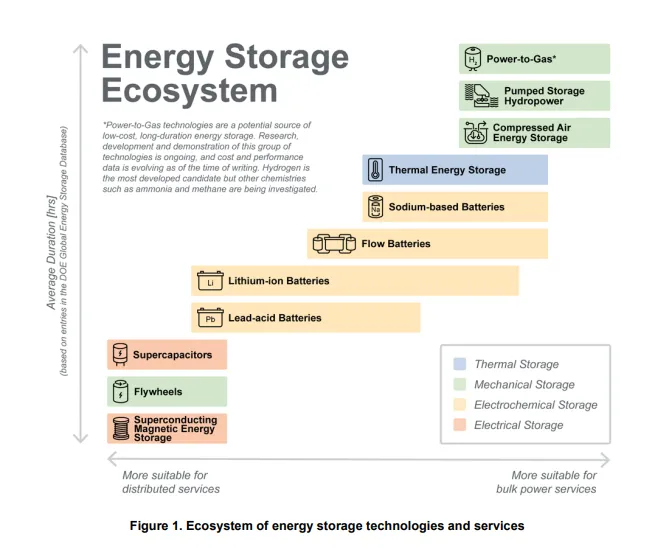
In our posts on storage use cases, we outlined the different ways in which storage devices can be applied to help smooth out the decarbonized power supply on the grid. In this section, we try to explain the main categories of storage technology, from the oldest and most established (pumped hydro) to the fastest growing (electrochemical) and onto some of the more niche categories that may well play an important part in due course.
Here's a great diagram from the USAID publication1, GRID-SCALE ENERGY STORAGE TECHNOLOGIES PRIMER to get us started.
This space is evolving at such a pace that it's hard to keep up. Read our sidebar post on market share and how dramatically & rapidly it's changed since 2020 when pumped hydro was the dominant category at over 92% of global capacity.
If you're interested to learn more about the terminology that applies, read our sidebar post on comparisons and note the attributes and caveats that apply.
- The distinction between power (measured in kilowatts / megawatts / gigawatts etc kW/MW/GW) and capacity (measured in GWh) - this is a common error
- Recently there's been a trend in serious publications to report both (e.g. "63 GW / ~150 GWh added in 2024)"
- The distinction between "utility-scale" and "behind the meter" battery storage
The electrochemical category leads the way in terms of growth. However, there's an urgent search for chemistries that rely on component materials that are more abundant, sustainable, recyclable and less damaging to extract than those used in Li-ion . There's renewed interest in novel technologies and even in older technologies with a new twist. In many ways, energy storage is the next great technology frontier of the energy transition.
In this section, we'll publish a succession of brief blog posts on the following battery categories:
- Electro Mechanical devices (incl flywheels/condensers)
- Gravity Batteries (incl pumped hydro)
- Electrochemical
- Compressed air
- Thermal
Finally read our post on energy to gas (hydrogen and biogas). These are not strictly speaking batteries, but can function in a grid storage use case.
Further Reading
- I keep a subscription to MIT Technology Review, Climate Change and Energy & like their regular coverage of novel technologies
References
- from USAID - GRID-SCALE ENERGY STORAGE TECHNOLOGIES PRIMER
- IEA (2024), Batteries and Secure Energy Transitions, IEA, Paris
- ESS News (2026), Big battery capacity jumps globally 12-fold in four years
- McKinsey (2021) - Long-duration energy storage for a renewable grid
- BloombergNEF (2025) - Global Energy Storage Boom: Three Things to Know
References
- The number of e-bike battery fires in NYC rose dramatically — from 30 in 2019 to 268 in 2023, and the 666 battery-triggered fires since 2019 have resulted in 28 deaths and 412 injuries. — E-Bike Battery Fire Hazards
- from USAID - GRID-SCALE ENERGY STORAGE TECHNOLOGIES PRIMER