
Grid Operations
If supply and demand don't match almost instantaneously, frequency & voltage swings are prone to occur. These can cause brownouts, blackouts, equipment damage and worse if instability cascades through the system. Read how Grid Operators maintain balance and stability to ensure smooth service.
In our last post, we took a look at how electrical grids have evolved to their modern state.
When did you last wonder as you plugged in your kettle or EV if the grid could handle your request for power? Think about how the great majority of the electrified world runs along without interruption. The reason we don't need to pause before plugging in is largely down to the practice known as Grid Operations
In my opinion, Grid Operations is one of the most sophisticated yet underappreciated disciplines serving the modern world. Allow me to convince you that there's no hype to that statement as we take a look in this post at the discipline.
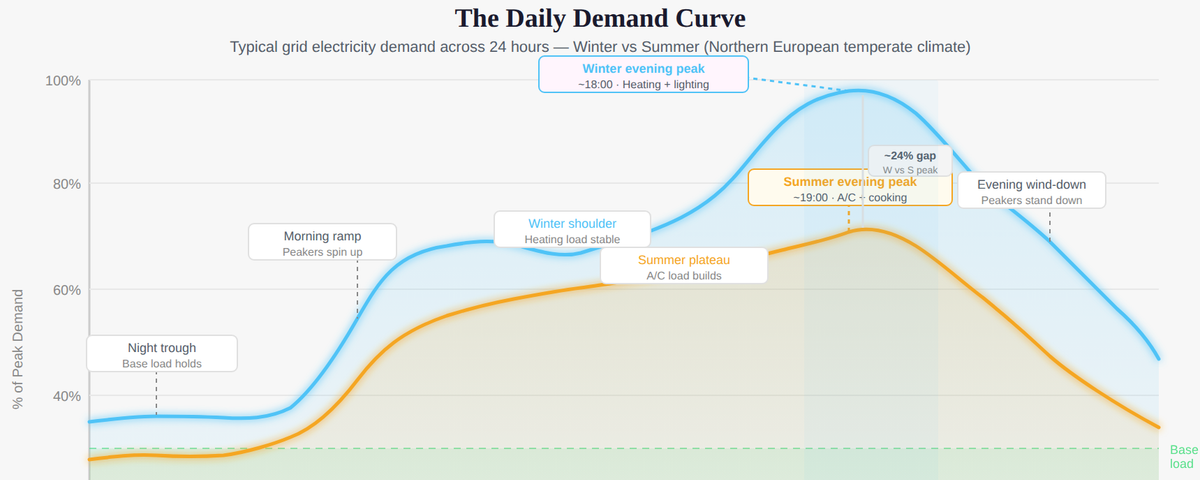
The Demand Curve is shorthand for the largely predictable daily demand cycle of power demand. Serving the Demand Curve requires Grid Operators to manage a variety of resources - long, medium and short term capacity, stability devices, interconnectors and more. Upsets to the expected rhythm of the Demand Curve can be caused by extreme weather, plant failure, accidental or wartime damage, sabotage. Avoiding blackouts, brownouts or surges and the potential for consequential damage means that variabilities and volatilities in demand and supply must be anticipated, buffered, managed.
Running a stable grid requires Grid Operators to match consumer demand with supply almost instantaneously - not just in aggregate but within logical segments of each grid. This is known as Grid Operations - the process of monitoring, controlling, and maintaining the electrical grid to ensure a reliable, efficient and precise supply of electricity to consumers. Response rates are measured in fractions of a second. High levels of automation apply to routine operations. More urgent intervention can occur where supply and/or demand nodes are adjusted up/down, with occasional load shedding in grid segments to avoid a wider outage
Base-load: In the fossil fuel paradigm, base-load power has mostly been provisioned by large-scale power plants (gas, oil, coal, peat, biomass) that produce high volume steam to drive turbines coupled to alternators or other generators.
Geothermal and hydro can deliver base-load but are terrain and topology dependent. They perform a limited share of provisioning globally. Nuclear power delivers base-load in certain regions.
Base-load facilities offer predictability and ballast, described as Inertia, that keeps the network at the correct frequency. Because they are optimised for large-scale base-load, they are generally poor at dealing with short term swings in demand.
Peak-load: Supply to meet daily peaks must be met by more reactive capacity that can spin up or down in line with daily demand swings. Often called "peaking" or "peaker-plants," these have been predominantly gas-fired, less efficient, more polluting, and often situated close to population centres near to where the greatest load swings tend to occur.
Stability: Short-term imbalances are smoothed out by high-inertia flywheels / condensers, supercapacitors and other short duration storage devices, with batteries a more recent alternative (see Further Reading from Bloomberg Green later in this post). Interconnectors perform an important function in peak load and short-term provisioning also.
Operators rely on Grid Services like frequency regulation, voltage support, spinning reserve (a term that originated in turbines idling at the lower end of their output rating but ready to ramp up to meet peak loads). Black Start capacity helps operators restore from shutdowns without stressing the wider Grid.
Demand Response occurs where consumers dial back on demand at select times to reduce stress on the grid, usually according to some commercial arrangement with the operator. The Smart Grid promises to enable this effort to be extended beyond commercial or industrial customers and into homes and individual devices.
On the supply side, as fossil fuel is retired from the energy mix, the Inertia it provided must be replaced with alternatives (e.g. storage at sufficient scale and responsiveness, grid enhancing technologies) to fully accommodate renewables on the Grid.
On the demand side, rising demand makes it likely that grid congestion will remain a material issue until grid buildout programmes catch up.
The job of balancing the decarbonized grid gets harder in the short term. Long term operability will rely on the following:
- Short duration energy storage to replace peaker plants (look at our post later)
- Long duration storage to provide inertia in base-load provisioning
- The Smart Grid (read later) evolving to far greater levels of automation
Read our post on Inertia next.
Further Listening
- 🎧 From "The Electricity Exchange" - listen to the first 10 minutes of the podcast
Further Reading
- 📖 From Bloomberg - On Grid stabilizing technology