
Storage in a decarbonized grid
A high-level look at how storage capacity might be deployed to the various zones and functions of the grid according as non-dispatchable power sources come to dominate.

We wrote previously about how the inertia brought by fossil fuels to the legacy grid has been essential to grid balance and stability. To function effectively, a Decarbonized Grid needs to develop a new model for balance and stability. Storage capacity is to be essential in this effort. It must be widely deployed to buffer, warehouse and dispatch energy so as to smooth out the variability of renewables. A new class of grid technologies must complement that storage capacity to replicate the inertia previously delivered by physically rotating equipment. Additionally, Smart Grid technology must drive automation levels well beyond what's in use today.
The storage category is forecast to grow strongly. BloombergNEF predicts 15-fold1 market growth by 2030. McKinsey estimates capacity in long-duration storage growing eightfold2 by 2040. In this section, we explore the different ways in which energy storage will be deployed to support the Decarbonized Grid.
We often hear the truism from skeptics that the sun doesn't always shine and the wind doesn't always blow. Wind and solar are fundamentally non-dispatchable in their raw form insofar as a grid operator cannot instruct a wind farm to produce more power when the wind isn't blowing, or call on a solar array after sunset. Output is determined by weather conditions, not by operational decisions. The term Dispatchable arises in this context. Dispatchable sources are those that can be called on by grid operators and dialed up/down at will to meet swings in demand. Fossil fuel generation is dispatchable to varying degrees. Coal, oil and gas are all dispatchable, gas being the most responsive.
Grid systems aren't nearly ready to connect decarbonised sources at the necessary scale or to deliver the increased power demand predicted in the NZE scenario. Though the effort is well underway in many regions, keeping up with the required pace of transformation will be an ongoing challenge in the coming decades.
Achieving a Decarbonized Grid means progressively switching off and retiring those fossil fuel plants that provide inertia to the grid. Storage is vital to this effort. It must smooth out the energy supply in different ways, upstream, midstream and downstream. Critically, storage must replace much of the standby capacity and stabilising presence of peaker plants.
In the NZE scenario, the grid is powered by an energy mix dominated by renewables, of which wind and solar are expected to deliver the greatest share. To look at the challenges presented by that likely energy mix, let's examine data from one of the greenest energy markets - the German grid. [Click through the link3 below to access an interactive version of the following graph.]
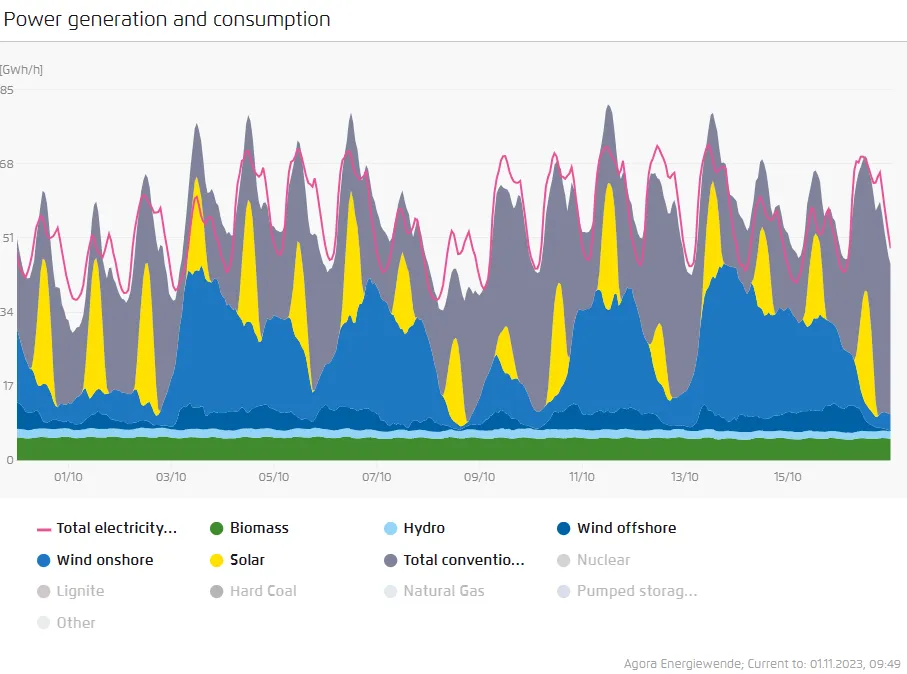
Consider the variability of renewables in the 16 day period across Germany (randomly chosen). Biomass (where Germany leads globally4) and Hydro (ranked 9th in Europe5) are predictable by comparison to Wind and Solar. Both categories are "dispatchable" - BioGas can be buffered or stored, water can be held back for controlled release. However growth potential in either category is limited by comparison with Wind and Solar.
Solar looks more predictable than wind in the period, but neither are dispatchable in any sense unless paired with storage capacity. The variability of the wind curve (particularly onshore) points to perhaps the greatest challenge for grid operators - deploying storage capacity of sufficient scale and functionality to support Energy Stockpiling (more on this later) - the storing of energy in large quantities for later use to smooth out wind and solar to the extent that fossil can be fully retired from the energy mix. There's a long way to go.
In this section, we attempt to provide context to how storage can function in a Decarbonized Grid. Read about it in successive posts as they issue:
- In Grid Operations - how storage helps maintain a stable and balanced grid
- In Virtual Power Plants - how virtualised storage can replace peaker plants
- In Curtailment Avoidance - how storage can be effective in reducing curtailment
- In Demand Management - how storage helps in peak shaving
- In Bulk Energy Shifting - how storage could help in capacity management and energy stockpiling
References
- From BloombergNEF - Global Energy Storage Market to Grow 15-Fold by 2030
- McKinsey - Net-zero power: Long-duration energy storage for a renewable grid
- Agora Energiewende - Electricity Data from Sept 30, 2023 through Oct 16
- International Hydropower Association - Europe Hydropower capacity (note infographic at bottom of page)
- From the World Biogas Association - Market Report