
Nuclear Power
In brief - the climate case for Nuclear Power

All nuclear power plants in service to date have relied on nuclear fission, the splitting of a heavy atomic nucleus — typically uranium or plutonium — releasing a large amount of energy in the form of heat, which drives turbines to generate electricity.
Nuclear power is very emotive and contentious:
- The arguments against nuclear power include the potentially catastrophic consequences of failures/accidents and the significant challenges in managing fuel rods once they reach the end of their useful life
- The arguments in favour of nuclear power are that its carbon intensity is bettered only by wind power, that it is one of the safest energy sources1, and that it is an important force in grid stability as fossil fuels are retired from the energy mix
Nuclear offers stable and predictable gigawatt capacity at a small fraction of the carbon intensity of coal2. Nuclear plants have extra-long lifetimes, up to 60 or even 80 years in some cases. It has a relatively small land footprint. We take a brief look at the technology in this post.
How it works (in brief)
Heat arising from the fission process within radioactive fuel rods generates high volume steam that drives turbines to deliver up to gigawatt scale power to the grid. Fuel rods need robust encasement and careful handling during and after their useful life when they continue to generate heat and radiation. The water systems that contain that heat and radiation must be robust, fault tolerant and sophisticated.
Designs that anticipate and manage extreme risk are essential, which explains to an extent why nuclear projects tend to be so expensive and prone to cost and schedule overruns
Though relatively rare, malfunctions can be catastrophic, with Chernobyl and Fukushima most widely known. Failures to water systems can cause ultra-risky scenarios, such as occurred in Fukushima when the backup systems were disabled by tsunami related flooding.
After slow decades comes renewed activity
Concerns have led to a depressed investment through the last three decades, all while we continued building thermal power plants fuelled by coal.
The ratios make for interesting reading. There is roughly 2,100 GW of coal-fired generating capacity in operation globally — across more than 2,000 plants3 — versus around 400 GW from approximately 415 nuclear reactors4. In 2024, coal generated around 10,700 TWh of electricity, roughly four times the ~2,700 TWh produced by nuclear. The contrast in carbon intensity between those two numbers is stark.
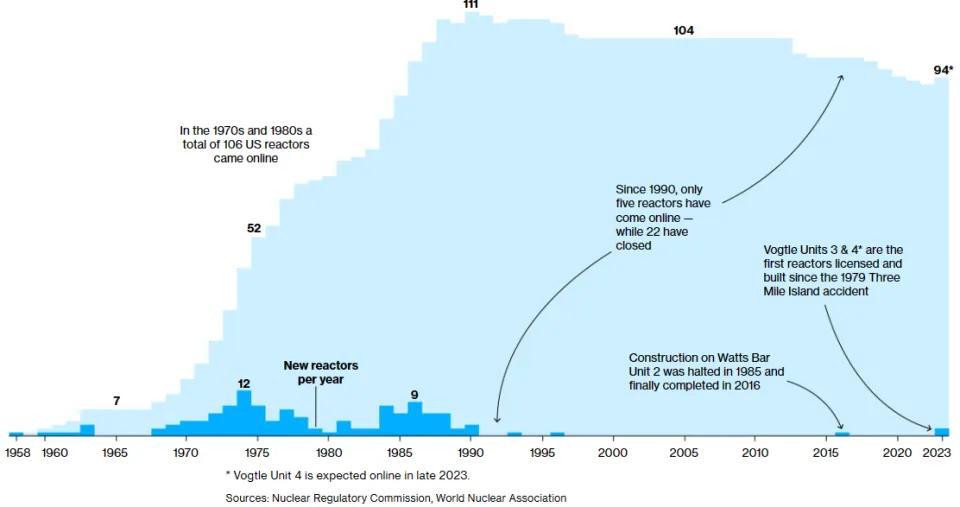
As is obvious from the graph5 - much of the USA's operating nuclear capacity runs on dated technology. Germany shuttered the last of its nuclear capacity in April 2023, but they are persisting with the use of lignite and other coals. It's worth noting that much of Germany's nuclear capacity was at or near end-of-life and that their stated intent is to retire coal use in due course.
After a long period of stagnation, nuclear is attracting renewed interest6. Advances in SMR (Small Modular Reactors) design offer the prospect of lower-cost, faster-build nuclear capacity. Fusion (though long talked about & still pre-market) is gaining traction. Whether this amounts to a lasting renaissance remains to be seen, but the mood has unequivocally shifted.
Proponents argue that it’s difficult to retire the bulk of the world’s carbon intensive generating capacity and deliver adequate base-load without Nuclear, most especially during the critical transition period of the next two decades.
A better version of nuclear power should be part of the discussion. However, nuclear projects have a reputation for cost overruns and extended delivery schedules - read about a recent decision to cancel a new SMR project due to surge in costs7.
A new wave of innovation suggests that nuclear fusion may provide a clean, safe, abundant and scalable power source. At the time of writing, the best estimate for commercial fusion is into the 2030's & it's thought to be at least the 2040's before the technology is to be widely available at commercial scale.
Videos worth watching
- 🎬 Watch how Finland plans to store Nuclear waste deep underground
- 🎬 Promotional for newcleo
- 🎬 Promotional for Natrium
- 🎬 Promotional for Rolls-Royce
- 🎬 Promotional for MMR
These links are shared in good faith, E&OE, *we have no connection with any of these companies - many are well funded but few are near to maturity
Further Reading
- Bloomberg’s article on the Vogtle project - Nuclear Plant $16 Billion Over Budget Arrives for Atomic Revival
References
- ourworldindata - Nuclear is one of the safest energy sources
- LSE - What is the role of nuclear in the energy mix and in reducing greenhouse gas emissions?
- Global Energy Monitor - Boom & Bust Coal 2025
- IAEA - Six Global Trends in Nuclear Power
- Bloomberg’s article on the Vogtle project
- IEA - Nuclear Reneissance
- Bloomberg - First US Small Nuke Project Canceled After Costs Surge 53%